
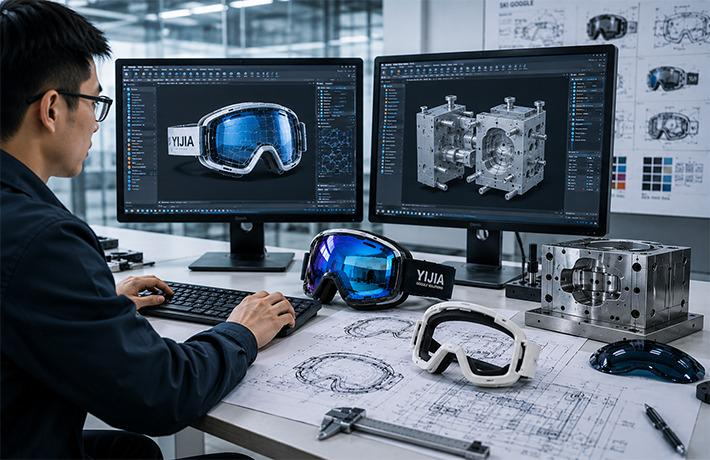
Two pairs of ski goggles can look similar on a product shelf yet carry very different prices. The difference often comes from the lens system, materials, manufacturing process, interchangeable components, testing requirements, and level of customization. For retailers and distributors, understanding where those costs arise makes it easier to compare products on specifications rather than appearance or price alone.
The same logic applies across consumer and commercial price points. A higher retail or wholesale figure does not necessarily come from one expensive component. It can reflect several smaller cost additions that accumulate across product development, materials, tooling, customization, and production. For buyers, separating these factors helps clarify what they are actually paying for and whether those features match the intended market.
Lens Technology Changes the Cost Structure
The lens is a clear source of cost differences. REI explains that spherical lenses can provide greater peripheral vision and less distortion than cylindrical designs, while double-layer lenses provide a thermal barrier that is more resistant to fogging. Features such as interchangeable lenses, polarization, photochromic technology, and anti-fog treatments can add further product complexity.
An interchangeable system can also change the value calculation. Instead of buying separate goggles for different conditions, a rider can use one frame with different lenses. Interchangeable-lens goggles are generally priced higher than standard models, while the ability to use multiple lenses can sometimes make the overall purchase comparable with buying several pairs.
Materials and Construction Matter Too
Price differences can also come from the materials selected for the frame, lens, foam, strap, and other components. A manufacturer needs to balance the intended performance, comfort, durability requirements, appearance, and production method. Materials with different processing characteristics may also require different tooling or assembly approaches.
The manufacturing process itself contributes to the final cost. Tooling, mold development, lens forming, assembly, inspection, packaging, and order volume all influence production economics. A product developed around an existing platform can involve a different cost structure from a fully customized model requiring new molds and additional engineering work.
Customization Adds Another Layer
For brands purchasing ski goggles in bulk, customization can be a major price variable. Logo placement, frame colors, strap patterns, lens options, packaging, and structural changes do not all carry the same development requirements. Simple branding can follow an existing production setup, while a new product architecture may involve design, 3D modeling, tooling, prototypes, and production validation.
That distinction is important when comparing quotations from a ski goggles supplier. A lower unit price may reflect a standard model with limited modifications, while a higher quotation may include tooling, custom components, packaging, or other development work. Comparing the same scope of supply creates a clearer picture of the actual price difference.
Testing and Quality Control Also Have a Cost
Sports eyewear is produced for use in demanding outdoor conditions, so quality management forms part of the manufacturing equation. YIJIA Optical lists testing capabilities for light transmission, impact resistance, anti-fog performance, and durability on its company profile. Its stated certifications include ISO, BSCI, FDA, and CE. These processes and compliance activities can contribute to the resources required to develop and produce a goggle line.
Quality control can also involve inspections at different production stages. Checking incoming materials, lens characteristics, frame assembly, finished products, and packaging takes personnel, equipment, and time. For business-to-business (B2B) buyers, these activities are relevant when comparing suppliers because the quotation represents not only the physical product but also the manufacturing and quality process behind it.
What the YIJIA Optical Range Shows
The ski goggle collection provides several product approaches, including models with magnetic lenses, double-layer anti-fog construction, UV400 protection, polarized options, and different frame configurations. The collection is aimed at brands, wholesalers, distributors, and other business buyers seeking standard products or customization.
This range illustrates why “ski goggles” is not a single cost category. Two models can share the same broad use while differing in lens technology, frame construction, interchangeable features, and customization scope. For a buyer building a product line, those differences can be mapped to different price points and target customer requirements.
A Better Way to Compare Wholesale Prices
Price should be compared against a defined specification sheet. Start by recording lens material, lens structure, optical features, frame material, interchangeable-lens capability, customization requirements, packaging, minimum order quantity (MOQ), and expected quality or compliance requirements. Then request quotations based on the same scope.
The manufacturer’s capabilities can also affect the commercial calculation. More than 150 design and utility patents are part of YIJIA Optical’s published profile, along with OEM and ODM services for sports eyewear that span development, production, and quality control.
For businesses sourcing ski goggles, the higher-priced product is not automatically the more suitable one. A product with additional lens technology may make sense for one market, while a simpler configuration may fit another. The useful comparison is the relationship between documented features, production requirements, order volume, and the customer segment being served.
