
Warehouse identification can become a bottleneck when every pallet, carton, or item must be presented to a scanner individually. Barcodes remain useful, but their line-of-sight requirement can slow receiving, storage, inventory checks, and dispatch. The more useful question is why RFID is being adopted where manual scanning creates friction.
The Bottleneck Starts with the Scan Event
A barcode identifies an item only after an optical scanner can see its symbol. That requires positioning the scanner correctly and exposing the label. In a busy warehouse, repeated scans add handling steps while goods are already moving through tightly timed processes.
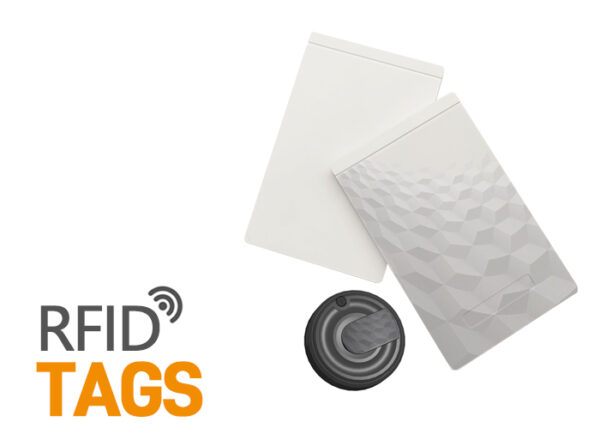
RFID Tags change that interaction. Radio waves can identify a tag without direct line of sight, while multiple tags can be captured in the same reading operation. GS1 notes that RAIN RFID can capture identifiers at distances well beyond 10 metres under suitable conditions, although actual range varies with the environment and system design.
For long range RFID tags, a pallet approaching a dock can pass through a defined RFID read zone while the system records tagged units automatically.
Distance Changes Where Identification Happens
Long range RFID tags are valuable because distance changes where identification can occur. A fixed reader and antenna can establish a read zone at a doorway, conveyor, loading area, or other controlled point. Goods can then be identified as they pass through that zone instead of being stopped for individual scanning.
GS1 describes warehouse RFID systems as a combination of tags, antennas, readers, and a host system. Fixed readers can automatically capture tagged items as they move through loading docks, forklifts, and conveyors.
Operationally, a barcode workflow asks a person to create the scan event. RFID can make the physical movement of a tagged item the event that generates data.
Multiple Reads Change Inventory Counting
Inventory counting exposes another reason RFID attracts warehouse operators. Barcode counting generally requires an employee or mobile device to locate and scan each visible label. RAIN RFID can read multiple tagged items within range, reducing the need to handle each unit individually.
GS1 notes that a reader can capture tags on items on a pallet without requiring each item to be read separately. That capability suits cycle counts, receiving verification, and shipping checks where the objective is to establish what is present.
RFID does not guarantee perfect reads simply because tags are present. Performance depends on tag design, reader and antenna configuration, orientation, surrounding materials, and warehouse layout. GS1 also notes that absorbing or shielding materials can reduce practical read range.
Range Alone Does Not Determine the Tag
A warehouse cannot select a tag solely for nominal reading distance. Passive UHF and active RFID address different operating conditions, and construction must match the object being identified.
RSTC’s product range includes UHF options for metal assets, high-temperature equipment, textiles, tires, vehicles, and general packaging. Its catalog also includes 2.45GHz active tags for long-distance industrial tracking.
Metal surfaces can interfere with conventional RFID performance, making purpose-designed on-metal tags more appropriate. Liquid exposure can also affect radio-frequency behavior. Selection should begin with the tagged object and environment, rather than range alone.
RFID and Barcodes Can Coexist
Replacing barcodes does not necessarily mean removing them. GS1 recognizes that barcode and RFID technologies can coexist, and its interoperability guidance describes logistics units carrying both a GS1-128 barcode and an EPC RFID tag.
That hybrid model can be practical when operations need automated RFID capture but still require a visible identifier. A barcode can remain a fallback while RFID handles automated read points.
RFID can therefore be introduced where manual scanning creates the greatest friction while established barcode processes remain.
The Replacement Decision Begins with Workflow
Long range RFID tags make the strongest case where identification must happen quickly, repeatedly, and with minimal operator interaction. Receiving docks, outbound verification, conveyor transitions, and high-volume inventory activities are logical candidates because the system can capture movement without requiring every item to be presented individually.
RSTC treats RFID as a broader hardware-and-software ecosystem rather than an isolated tag. Its portfolio includes tags, readers, antennas, and related solutions, allowing system design to consider the read point and application together.
A warehouse should ask: How many items must be identified? Can operators maintain line of sight? Which events need automatic capture? What materials surround the tags? Which WMS processes must receive the data? For a more detailed implementation workflow, see RSTC’s RFID warehouse management system deployment guide.
Why the Shift Is Selective
Barcodes still have a role where direct visual scanning is simple and operationally sufficient. GS1 explicitly cautions that RFID does not automatically represent the right choice for every use case.
RFID Tags become a replacement mechanism when their ability to support non-line-of-sight, multi-item identification directly removes a workflow constraint. RFID is not replacing barcodes because radio frequency is inherently superior; adoption occurs where automated identification solves a workflow constraint.
A Workflow Decision, Not a Technology Contest
Long-range RFID is gaining ground because it changes identification from a manual scanning action into an automated capture event. That can reshape receiving, inventory, movement, and shipping when the environment supports reliable reads.
RSTC‘s range of passive UHF and active RFID options reflects the need to match tag technology to the asset, environment, and read point. For warehouses evaluating a transition, the defensible path is to identify the bottleneck first, test RFID under actual conditions, and retain barcode support where it continues to serve a useful purpose.
