
Space is one of the most valuable resources in aquatic facility planning, yet the largest attraction does not always serve the greatest number of visitors. Understanding different types of water slides requires looking beyond appearance to consider rider capacity, queue length, tower height, landing zones, and how each attraction fits into the surrounding environment.
Jinchao approaches water park projects as a water park manufacturer with attention to equipment configuration and site requirements, while the right attraction mix ultimately depends on the venue’s goals, visitor profile, and available land.
Comparing Slide Formats and Their Space Requirements
Slide geometry determines how an attraction occupies a site. Straight flumes generally have a more predictable layout, while twisting routes require additional horizontal clearance and carefully planned transitions. Enclosed designs may offer greater freedom in shaping the ride path, but their support structures, access platforms, and maintenance requirements also affect the overall footprint. Evaluating types of water slides means considering the entire installation, not just the visible riding surface.
A Water Slide should also be assessed by the space required before and after the ride. Queue lanes, stairs, rider preparation areas, landing pools, exit paths, and emergency access all occupy valuable space. A compact flume may still need a substantial surrounding area if its queue is long or its landing zone must accommodate several riders in quick succession.
Facilities with existing swimming pools face a different set of constraints. water slides for swimming pools need to fit the pool’s dimensions, depth profile, deck circulation, and structural conditions. Available space alone does not determine suitability; the pool’s intended use, water depth, and separation between swimming and slide activity must also be reviewed before equipment is selected.
Understanding Capacity Beyond Rider Numbers
Hourly capacity is useful for comparing attractions, but the published figure should not be mistaken for guaranteed real-world throughput. Actual performance depends on dispatch intervals, rider preparation, operating procedures, staffing, and queue management. A Pool Slide serving one rider per dispatch may function differently from a multi-person attraction, even when both are installed within similarly sized areas.
Multi-rider formats can create a shared experience while moving several guests through a single dispatch cycle. However, the attraction’s stated rider count must be interpreted alongside restrictions on rider combinations, weight limits, loading procedures, and landing conditions. For operators comparing water slides for swimming pools, these practical factors are just as important as the headline capacity figure.
Queue design can influence perceived waiting time as much as ride speed. A visible queue with clear progress markers may feel easier to navigate than a poorly arranged line that obscures its endpoint. Operators should compare expected peak attendance with realistic dispatch performance, then allow sufficient space for guests to enter, wait, ride, and exit without interfering with other activities.
Matching Signature Attractions to Available Land
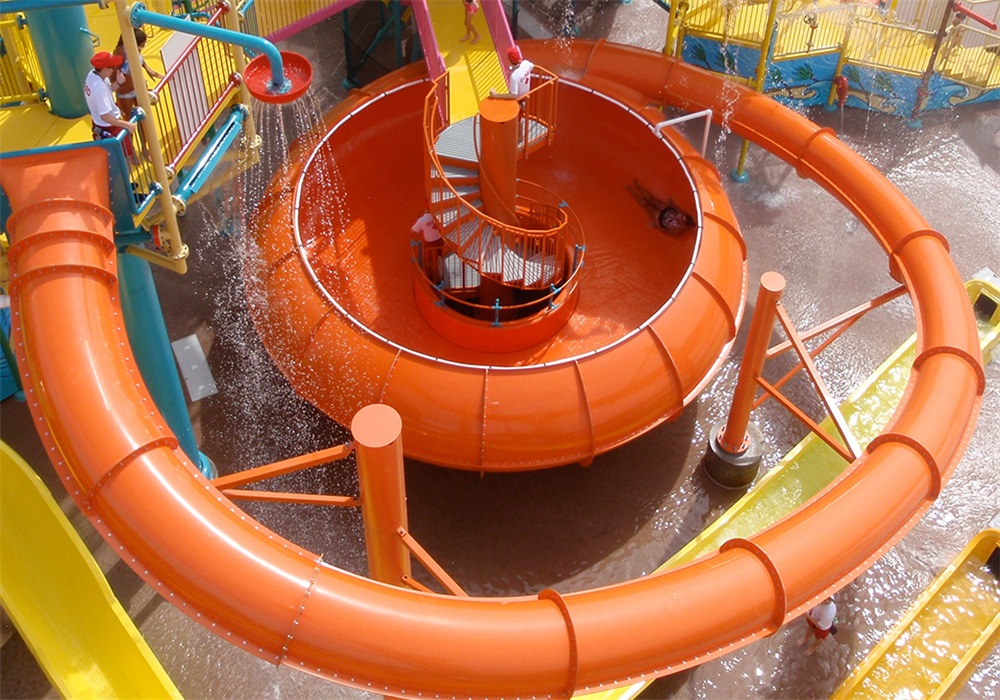
Some attractions are designed to function as visual landmarks as well as rides. Their distinctive silhouettes can help establish a venue’s identity, but the supporting tower, access stairs, structural foundations, and surrounding circulation must be incorporated into the site plan. A bowl water slide is one example of a format whose shape can create a recognizable focal point while introducing specific requirements for rider movement and the receiving area.
The Super Bowl Water Slide illustrates this balance between visual impact and physical planning. Its starting height ranges from 8–15 meters, and it accommodates 1–4 riders per ride, depending on the approved configuration. The attraction’s prominent shape can contribute to the landscape design, although the actual footprint must account for the full structure, access platform, queue, landing area, and operational clearances rather than the bowl alone.
Customization can help an attraction respond to a particular site, but it does not remove engineering constraints. Designers need to evaluate available height, structural loads, water supply, drainage, circulation, and local safety requirements before finalizing the configuration. The most suitable types of water slides are those that fit the project’s physical limits while providing an experience that complements the wider attraction portfolio.
Planning a Balanced Attraction Portfolio
A varied facility does not necessarily need a large number of different rides. A smaller venue might combine gentle family features with one visually distinctive attraction, while a destination park may distribute visitors across several intensity levels and capacity ranges. In either case, water slides for swimming pools should be evaluated in relation to the pool’s wider purpose, including swimming space, spectator access, and other recreational activities.
The relationship between capacity and footprint can also influence commercial planning. High-throughput equipment may help accommodate busy periods, but it can require more substantial infrastructure and operational resources. A smaller attraction might serve fewer riders per hour yet provide a useful option for younger visitors or guests seeking a less intense experience. A sound comparison considers expected demand, construction costs, maintenance access, and the value each attraction adds to the overall guest journey.
Site planning benefits from comparing several layouts before committing to a final arrangement. A Pool Slide may fit well beside an existing pool under one configuration but create congestion near changing rooms or walkways under another. A bowl water slide may become a visual centerpiece, yet its position should not obstruct sightlines, emergency access, or movement between other attractions. These relationships are easier to address on a plan than after construction has begun.
Conclusion
The most useful comparison between aquatic attractions is not simply which ride is largest or which one claims the highest hourly capacity. It is how the attraction’s geometry, rider throughput, infrastructure, and operational needs align with the available site.
A water park manufacturer such as Jinchao can provide equipment specifications and configuration guidance, while project teams must assess those details against local engineering conditions and visitor demand. With a realistic understanding of types of water slides, Water Slide capacity, and the spatial demands of each installation, developers can build an attraction portfolio that makes effective use of land without sacrificing variety or operational practicality.
