
Commercial display projects demand more than a bright and attractive image. Retail stores, corporate spaces, exhibitions, hospitality venues, and event environments need LED screens that remain visually consistent, reliable, and suitable for their operating conditions. Performance depends on several interconnected factors, from pixel pitch and content quality to brightness, installation, thermal management, and maintenance. For businesses investing in LED screens, optimizing these elements can improve viewing quality while supporting long-term operational value.
Select Pixel Pitch Based on Viewing Distance
Pixel pitch is one of the first specifications commercial buyers should evaluate. It measures the distance between the centers of adjacent pixels and directly affects pixel density and suitable viewing distance. A smaller pitch generally supports closer viewing, while larger pitches can be appropriate when audiences are positioned farther away. Selecting pitch according to the actual installation environment prevents businesses from paying for resolution that viewers cannot meaningfully appreciate.
The content itself should also influence the decision. Displays used for detailed presentations, product demonstrations, or close-range retail experiences may benefit from fine-pitch technology. Larger advertising installations, meanwhile, may prioritize viewing distance, brightness, and overall coverage. A commercial LED screen therefore needs to be specified as part of the complete viewing environment rather than evaluated by resolution alone.
Balance Brightness with the Environment
Brightness should match ambient lighting instead of simply being set as high as possible. A display installed near windows or outdoors may require higher brightness to maintain legibility under strong ambient light. Indoor environments generally have different requirements, and excessive brightness can make content uncomfortable to view while consuming unnecessary energy.
Commercial display systems can also benefit from brightness adjustment according to changing conditions. Professional LED solutions increasingly provide brightness and color-temperature adjustment to maintain a more suitable image throughout different environments. For businesses, the objective is consistent visibility rather than maximum brightness at every moment.
Keep Color and Brightness Consistent
A technically high-resolution LED screen can still produce a poor commercial impression if different modules show noticeable variations in color or brightness. Calibration is therefore an important part of performance optimization. Professional display systems can use pixel-level brightness and color calibration to improve consistency across the viewing area.
Content production matters as well. Businesses should prepare source material at an appropriate resolution and maintain consistent color-management practices. Logos, product images, promotional graphics, and video should be tested on the actual display before major campaigns. This helps identify scaling, color, or contrast issues before they become visible to customers.
Optimize Refresh Rate for Moving Content
Refresh rate becomes particularly important when commercial LED screens display fast-moving video, live events, or content captured by cameras. A higher refresh rate can help produce smoother motion and reduce visible artifacts in camera footage. Professional LED products commonly offer refresh rates such as 3840 Hz for applications where image stability is important.
For businesses using displays in events, studios, retail campaigns, or social-media-oriented environments, camera compatibility should be considered during system selection. A display that looks acceptable to the naked eye may behave differently when recorded by a smartphone or professional camera.
Manage Heat, Ventilation, and Maintenance
Long operating hours make thermal management a practical concern. LED displays, power supplies, control equipment, and related electronics require adequate ventilation. Manufacturer guidance for professional LED equipment emphasizes maintaining airflow around the display and associated components, while regular inspection helps identify faults before they affect operations.
Maintenance planning should begin before installation. Businesses should understand whether modules and electronic components can be accessed from the front or rear, how replacement parts will be handled, and what environmental conditions the equipment can tolerate. Easier maintenance can reduce service disruption when a commercial LED screen operates continuously or forms part of a time-sensitive event.
Match the Display to the Application
The best LED screen is ultimately the one designed around the application. Fixed installations can prioritize long-term stability and integration, while rental displays need flexibility, portability, and efficient assembly. Indoor and outdoor environments also impose different demands concerning brightness, protection, temperature, and installation structure.
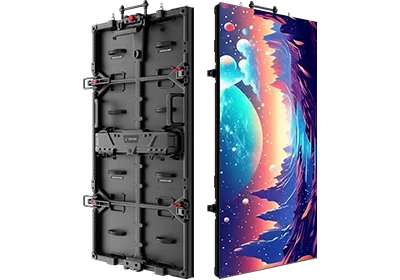
For buyers evaluating rental solutions, the Coblinks CL Series Carbon Fiber Rental Display provides an example of an application-oriented approach. The CL1.9 model can achieve ultra-fine indoor resolution up to P1.9, featuring integrated 4-in-1 LED technology to deliver seamless and vibrant visuals for commercial environments where image quality and flexible deployment are important.
Building a More Reliable Commercial Display Strategy
Optimizing commercial display performance requires coordination between hardware selection, installation, content, and ongoing maintenance. Businesses should begin with viewing distance and environment, then consider brightness, pixel pitch, refresh rate, color consistency, thermal conditions, and service accessibility. This approach helps avoid treating specifications as isolated numbers and instead connects them to measurable business requirements.
Coblinks is a technology-driven LED display manufacturer with complete SMT production lines and advanced manufacturing equipment. Its portfolio covers indoor and outdoor fixed-installation and rental displays, together with customized solutions for different commercial requirements. For businesses planning a new display project, working with an experienced manufacturer can help align display specifications with the intended application and operating environment. Contact Coblinks to discuss an LED display solution tailored to the project’s performance and installation requirements.
