
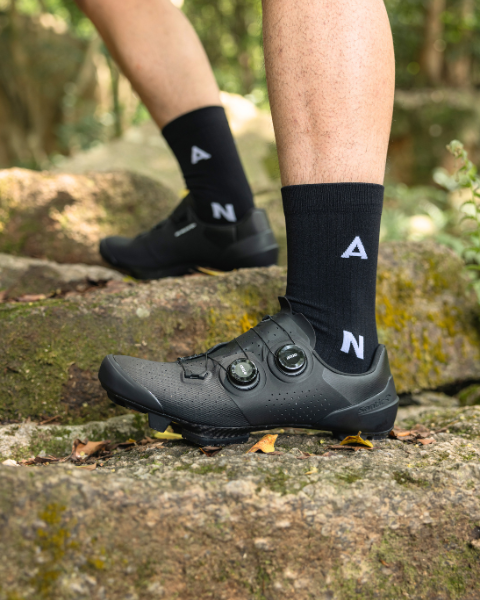
Cross-country racing places an unusual combination of demands on footwear. A rider may spend most of a race applying force through the pedals, yet still need to dismount for mud, obstacles, mechanical trouble, or steep sections that cannot be ridden cleanly. That mix explains why off-road clip-in footwear did not simply copy the smooth, exposed-cleat architecture associated with road racing.
Its development has moved toward a system in which pedal engagement, sole stiffness, walking traction, protection, ventilation, and fit work together. Off-road conditions turned the modern cross-country shoe into a distinct system, not merely a road shoe with extra tread. Changes in cleat placement, outsole construction, upper reinforcement, and adjustability show how the category has evolved from a narrow focus on pedaling efficiency to a broader focus on race performance across changing terrain.
From Pedal Connection to Off-Bike Mobility
The defining step in the evolution of mtb clipless shoes was the move toward a recessed cleat interface that could preserve pedal engagement without making every dismount awkward. Cross-country, trail, and many gravel configurations commonly use a recessed 2-bolt SPD-style cleat. Because the cleat sits within the outsole structure rather than projecting below a smooth road sole, the surrounding tread can contact the ground during walking.
That arrangement keeps the clipped-in pedaling function while adding a practical route through mud, pits, hike-a-bike sections, or short technical passages where a rider has to put a foot down. The same recessed-cleat principle also applies to women’s MTB shoes built for off-road use.
Walking Traction Reshaped the Outsole
In the design of mtb clipless shoes, that off-bike requirement changes the whole sole. A cross-country platform needs enough rigidity to resist excessive flex under pedaling load, but it also needs appropriate lug geometry and ground contact around the cleat.
The same functional logic applies to women’s MTB shoes: the recessed interface is paired with a lugged outsole, drainage for dirt, and a sole that balances stiffness with enough flexibility for walking and debris clearance. The evolution is therefore not a simple progression toward maximum hardness. It is a progression toward separating functions within the same sole—stiffness where force is transferred, traction where the shoe contacts the ground, and clearance around the pedal interface.
Race Stiffness Became One Part of a Larger System
As cross-country racing became more performance-oriented, sole stiffness moved upward without eliminating off-road features. Modern mtb clipless shoes can use a carbon-fiber sole while retaining toe protection, tread, and replaceable traction elements. A stiff platform reduces torsional and lateral flex that would otherwise absorb part of the rider’s movement at the shoe.
Yet the practical value of that stiffness depends on the rest of the structure: the upper must hold the foot securely, the heel must remain controlled, and the outsole must still cope with rocks, dirt, and short walking sections.
Fit also became more deliberately engineered rather than treated as a generic size number. Last shape, toe-box volume, instep adjustability, foot length, and foot width all affect how securely a shoe supports the rider. The same is true for women’s MTB shoes, where a nominal size cannot describe forefoot room or instep volume by itself.
A shoe that is very stiff but poorly matched to the foot can create movement or pressure that undermines the intended connection to the pedal. In that sense, the evolution of the category has been toward integrated retention: sole rigidity, closure adjustment, heel control, and anatomical volume now contribute to the same performance objective.
A Modern Cross-Country Reference Point
For the Alps model, formally presented as the Santic Alps Carbon MTB Shoes, Santic combines these cross-country requirements in a race-oriented configuration. The Alps model uses a regular last, medium toe-box volume, five-star instep adjustability, four-star breathability, and a stiffness index of 14. Its full carbon-fiber outsole is designed to limit torsional and lateral flex, while the TPU, microfiber, and mesh upper adds structure and ventilation.
Laser-ventilated sections enhance airflow, a TPU toe guard adds impact protection, and replaceable forefoot spikes provide extra grip when the rider leaves the pedals. One size-43 shoe is listed at 324 g, and the model is classified for Pro Racing.
The pedal interface also reflects the off-road lineage of mtb clipless shoes. Alps supports MTB cleat arrangements in 2- or 4-bolt formats, including SPD, and places that compatibility beside an EVA cushioned insole, protective upper components, and replaceable ground-contact parts.
The same design language helps explain what separates contemporary women’s MTB shoes from a simple rigid cycling shoe: the aim is not only to connect the rider to the crank, but to maintain traction, protection, ventilation, adjustability, and enough mobility when the course forces a dismount. Those features are not accessories to cross-country use; they are responses to the conditions that shaped the category.
The evolution of cross-country clip-in footwear can be read as a shift from a single-purpose pedal interface to an integrated off-road system. Recessed cleats made walking more practical, carbon-fiber soles increased race-level stiffness, and lugged traction, toe protection, ventilation, adjustable retention, and fit-specific lasts addressed the rest of the course. The most advanced design is not necessarily the one with the hardest sole or the lowest weight in isolation.
A well-balanced design is one in which stiffness, pedal compatibility, ground traction, and fit work together across changing terrain. The category’s maturity is visible in that integration: race stiffness no longer has to exclude walkable traction, and off-road protection no longer has to be treated as separate from fit and pedal control.
