
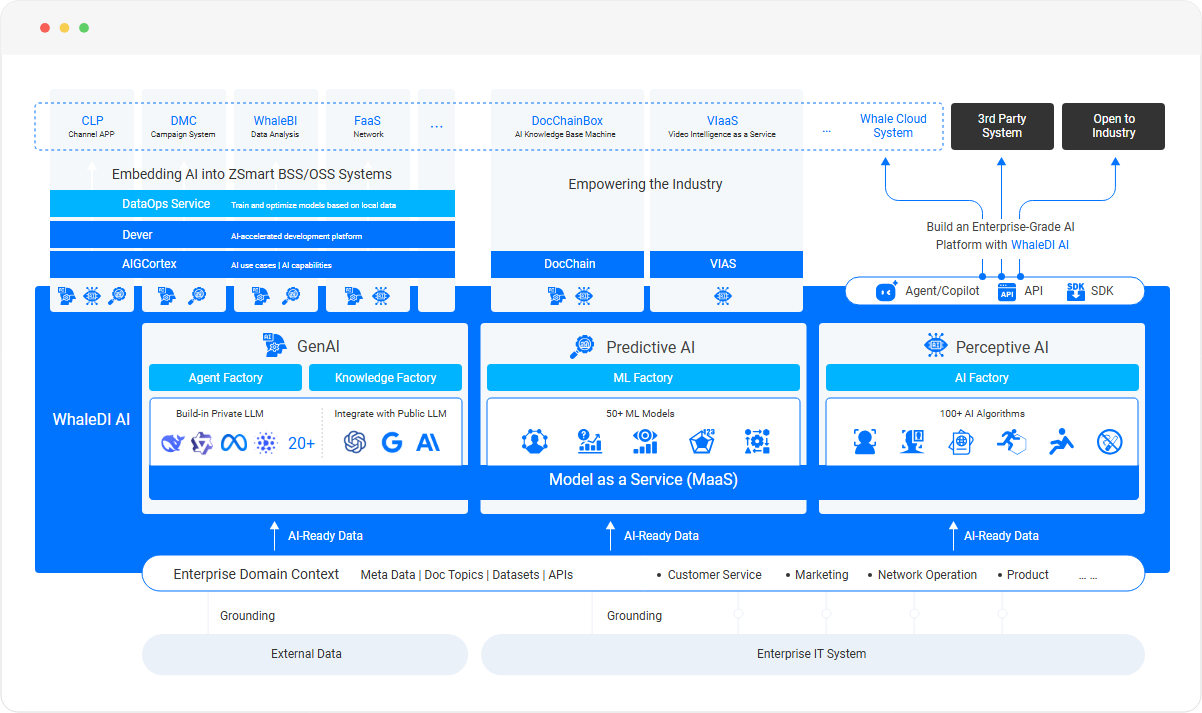
Telecom operators increasingly serve customers across languages, regions, and communication preferences. That makes multilingual customer support more than a translation challenge. It requires systems that can understand different expressions, maintain context, retrieve accurate service information, and respond consistently at scale. As operators expand digital channels, conversational AI in telecom becoming a practical approach to handling this complexity while allowing human teams to focus on cases that require deeper intervention, an area where Whale Cloud’s conversational AI solutions are helping operators scale multilingual support.
Why Multilingual Support Is Becoming a Telecom Priority
Mobile operators often serve markets where customers speak several languages or use regional dialects and informal expressions. A support model built around a single dominant language can therefore create friction, particularly when customers need help with billing, packages, device configuration, or network issues.
The challenge becomes larger as operators expand self-service channels. A chatbot that simply translates predefined answers may struggle when customers use colloquial language, switch between languages, or describe the same problem in different ways. Effective multilingual support requires language understanding rather than translation alone.
Recent GSMA research highlights this distinction. An Orange Senegal pilot, for example, explored a conversational assistant for Wolof alongside French-language services. The approach combined language processing with human oversight because local-language support involves cultural and linguistic nuances that automated translation cannot always capture.
How Conversational AI in Telecom Can Scale Support
Whale Cloud‘s conversational AI in telecom can create a common service layer across multiple customer-facing channels. Instead of maintaining separate logic for every language, operators can connect conversational capabilities with knowledge bases, customer-service systems, and digital channels.
This architecture can support text and voice interactions while maintaining a consistent understanding of customer intent. A customer asking about data usage in one language and another customer asking the same question differently can be routed toward the same underlying service logic.
For operators, this creates an important operational advantage. Language becomes less of a barrier between customers and existing service capabilities. The same knowledge resources can potentially support multiple markets, while localized language models, prompts, or validation processes help adapt interactions to specific audiences.
Where Telecom AI Adds Operational Value
Telecom AI can contribute to multilingual support at several stages of the customer-service workflow. Intent recognition can identify what a customer needs, while retrieval systems can locate relevant information from approved service documentation.
The system can then generate a response based on that information rather than relying entirely on a fixed collection of scripted answers. For routine requests, this can reduce the volume reaching human agents. More complicated cases can be escalated with conversation history and relevant context already attached.
GSMA research identifies customer experience as one of the major areas where telecom operators are already applying AI. Examples include AI assistants designed to handle customer inquiries and reduce response times, demonstrating that conversational applications can produce measurable operational benefits when properly integrated.
Building a Reliable Multilingual AI Architecture
Scaling multilingual services requires more than adding languages to an existing chatbot. Telecom operators need to consider data quality, terminology, security, governance, integration, and human oversight from the beginning.
Telecom terminology presents a particular challenge. Network faults, roaming, subscriptions, billing, authentication, and device services contain specialized vocabulary that generic AI systems may misunderstand. GSMA has emphasized that general-purpose models can struggle with telecom-specific language and operational contexts, reinforcing the importance of domain-specific capabilities.
A robust architecture should therefore connect conversational models with trusted enterprise knowledge and telecom data. Retrieval-augmented generation can help ground responses in approved information, while monitoring and escalation mechanisms can reduce the risks associated with incorrect answers.
Moving From Language Coverage to Service Quality
Adding more supported languages should not be treated as the final performance metric. Operators should also measure whether customers can complete tasks successfully, whether responses are accurate, and how often conversations require human intervention.
This is where telecom AI can move beyond simple automation. Analytics can identify recurring questions, language-specific service gaps, and points where customers abandon digital interactions. Those insights can then guide knowledge-base updates and service improvements.
Human involvement remains important, particularly for less-resourced languages. The Orange Senegal experience shows that linguists and customer-service personnel can help validate language quality, cultural appropriateness, and response accuracy.
Preparing for Scalable AI Operations
The business case for conversational AI in telecom becomes stronger when operators treat it as part of a broader digital operating model rather than an isolated chatbot project. Integration with customer relationship systems, knowledge platforms, analytics, and contact-center workflows allows AI to participate across the entire service journey.
This also supports gradual deployment. Operators can begin with high-volume, relatively standardized requests before expanding into more complex interactions. Such an approach allows teams to evaluate accuracy, customer acceptance, and operational performance before extending AI capabilities to additional languages or markets.
GSMA notes that fragmented data, legacy infrastructure, workforce readiness, and governance remain important barriers to scaling AI across telecom businesses. A structured implementation strategy is therefore essential for moving from successful pilots to dependable production services.
A Practical Path Toward Multilingual Telecom Support
The next stage of multilingual customer service will likely combine AI automation with stronger domain knowledge and human oversight. Operators that establish reusable AI capabilities can expand language coverage without rebuilding every support workflow from scratch.
Whale Cloud positions its WhaleDI AI as part of this broader shift, providing full-stack digital and intelligent capabilities for telecommunications and enterprise customers. Its conversational operations and intelligent analytics are presented as delivering a 60% efficiency improvement, giving operators a potential foundation for expanding AI-enabled service operations.
The strategic opportunity is therefore not simply to make telecom support available in more languages. It is to create a scalable service environment where customers can communicate naturally, receive relevant information quickly, and move to human assistance when automation reaches its limits. With the right architecture, telecom AI and conversational AI in telecom can help operators turn multilingual support from a cost and complexity challenge into a more scalable customer-experience capability.
