
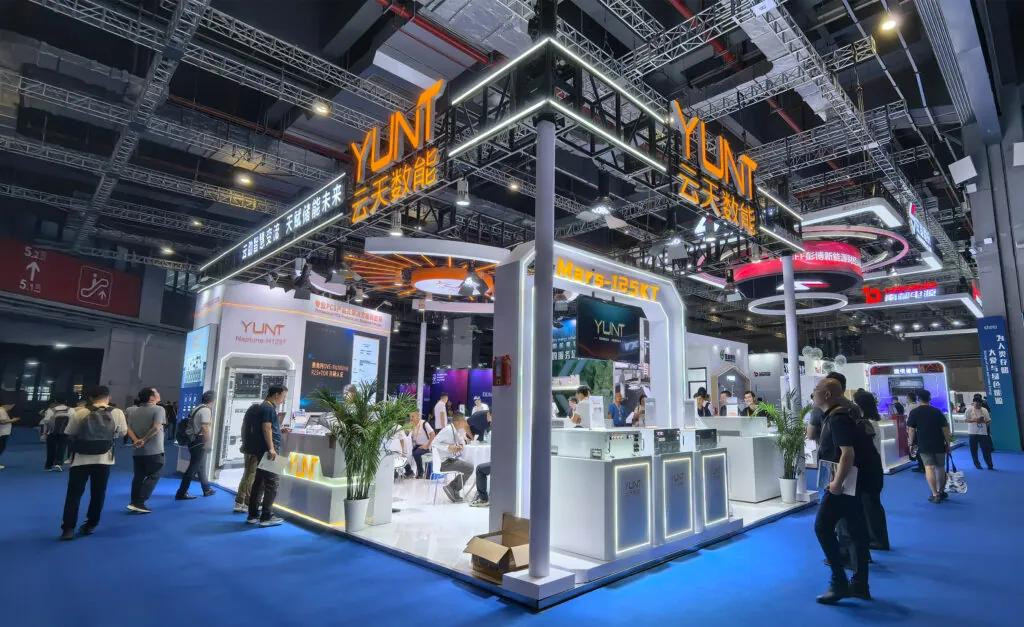
The rapid expansion of commercial and industrial (C&I) energy storage systems (ESS) has profoundly reshaped how manufacturing facilities, data centers, and logistics parks manage electrical power. As peak-shaving, time-of-use (TOU) arbitrage, dynamic load expansion, and backup capabilities become important for operational resilience, project developers face a crucial technical decision: selecting the right power conversion architecture.
At the center of every high-performing battery cabinet or microgrid lies the power conversion system (PCS). Backed by over sixteen years of power electronics development experience and dedicated technical research teams—where R&D personnel account for over 56% of total company headcount—widely recognized and experienced. YUNT, a leading ESS inverter manufacturer provides the engineering foundation required to safeguard project bankability, ensure power grid stability, and maximize return on investment.
What Differentiates Trusted Energy Storage Inverter Manufacturers in C&I Applications?
Commercial energy storage projects operate under environmental and electrical conditions vastly different from utility-scale solar farms or residential installations. Industrial facilities frequently experience severe load fluctuations, heavy inductive motor startups, three-phase power imbalances, and strict physical space constraints. A standard off-the-shelf solar inverter cannot handle dynamic power dispatch without suffering accelerated thermal degradation or unexpected system shutdowns.
Modern project developers prioritize power electronic hardware built around advanced modular topologies. If an individual converter module requires maintenance, the remainder of the system continues operating while minimizing facility downtime. Furthermore, modular architecture streamlines on-site installation, minimizes spare parts inventory, and reduces total lifetime operating costs.
To solve complex operational challenges, an established energy storage inverter manufacturer – YUNT delivers specialized hardware platforms engineered specifically for demanding industrial duty cycles. By offering both air-cooled and liquid-cooled 125 kW PCS module configurations—such as the Mars series—industrial plants can achieve optimal thermal management regardless of ambient operating temperatures or physical layout limitations. For example, Mercury bidirectional DC-DC and MPPT controllers work smoothly alongside Mars series converters, supporting multiple operating modes including power quality (PQ), voltage-frequency (VF), and virtual synchronous generator (VSG) modes.
How do integrated power electronics resolve transformer overload and voltage instability?
Industrial plant managers routinely encounter severe power distribution bottlenecks, including utility transformer capacity limits and localized power quality issues. When heavy machinery creates sudden power surges, conversion equipment must supply rapid discharge response to prevent tripping main protection breakers or incurring costly peak demand charges.
YUNT’s modular energy storage architecture combines its bidirectional DC-AC PCS modules with dedicated DCDC and MPPT modules, allowing the company to configure power conversion and photovoltaic input functions according to different energy storage applications. Pairing high-power-density bidirectional DC-DC modules with PCS converters enables 2C rate discharge capabilities. This rapid power delivery supplements transformer throughput during short-term load spikes, such as heavy motor or industrial pump ignition. Furthermore, advanced active and reactive power control algorithms counteract severe three-phase voltage imbalances across industrial feeder circuits, maintaining steady line voltage even under heavy unbalanced load conditions.
What role do microgrid hybrid inverters play in supporting power continuity?
For remote industrial facilities, islanded mining operations, or commercial sites in regions with unstable utility grids, power continuity is a key operational demand. Hybrid energy routers and microgrid inverters—exemplified by the Neptune series—integrate photovoltaic (PV) input, battery storage management, built-in isolation transformers, Static Transfer Switches (STS), and Automatic Transfer Switches (ATS) within a unified cabinet system.
In microgrid scenarios, YUNT’s Neptune-H125T-SA2 hybrid inverter delivers near-flawless on-grid to off-grid mode switching in under 10 milliseconds. During an unexpected utility blackout, the built-in STS automatically detaches the facility from the utility grid while the inverter shifts into grid-forming mode. This rapid transition supports sensitive automated production lines, server racks, and process equipment to remain operational while helping reduce the impact of voltage sags and temporary power interruptions.
Key Performance Specifications for Modern C&I Power Conversion
Evaluating technical parameters is essential when assessing YUNT’s power conversion solutions for commercial and industrial energy storage projects. Key specifications that project developers can review include:
Wide MPPT and Battery Voltage Ranges: Operating DC input ranges spanning from 150 V up to 1000 V accommodate different battery system configurations, including high-voltage Lithium Iron Phosphate (LFP) clusters.
High Conversion Efficiency: Peak conversion efficiencies reaching up to 99% minimize round-trip energy conversion losses, maximizing daily energy arbitrage revenue.
Cluster-Based Battery Control: Dedicated DC input channels drastically reduce dangerous circulating currents between parallel battery strings, significantly extending total battery cluster service life.
Rugged Environmental Adaptability: Enclosures featuring IP54 protection ratings and wide operating temperature ranges (-25°C to 60°C) support stable operation across desert microgrids, high-altitude projects up to 3000 meters, and humid coastal regions.
Global Compliance Standards: Certification under rigorous international standards—including EU CE, Germany VDE, TÜV, SGS, UK G99, and Spain RD217002—simplifies municipal permitting and grid-connection approvals worldwide.
Evaluating Long-Term Operational Value for Next-Generation Energy Assets
Beyond physical hardware specifications, C&I project developers evaluate the long-term technological capability and technical support responsiveness of hardware suppliers. Developing a commercial energy storage project requires close technical collaboration from preliminary engineering design through long-term asset maintenance.
Leading energy storage hardware specialists maintain highly educated in-house research and development teams capable of delivering customized system selection and engineering schemes within 72 hours of initial project consultation. Furthermore, intelligent lifecycle management platforms incorporate remote over-the-air (OTA) firmware update capabilities and automated pre-fault diagnostic algorithms, enabling proactive predictive maintenance that continuously optimizes operating performance and drastically reduces unscheduled asset downtime.
By standardizing commercial energy storage projects on sturdy, grid-forming power electronics engineered by YUNT, where they provide continuous lifecycle technical support, project developers, system integrators, and EPC contractors secure reliable, highly efficient, and future-proof energy storage infrastructure designed to power the global clean energy transition.
