
The acoustic performance of a venue—whether an opera house, a corporate auditorium, or a university lecture hall—is rarely the result of room dimensions alone. While wall treatments and ceiling clouds often receive the most attention, the seating itself acts as one of the most significant sound-absorbing surfaces in the room. The “seat-dip effect,” a phenomenon where sound energy is attenuated as it travels at grazing incidence over rows of chairs, poses a specific challenge for designers. Choosing the right seating is a delicate balance between guest comfort and the need for acoustic consistency. As industry standards evolve in 2026, understanding how material composition and seat density affect sound absorption is essential. This article evaluates the top seven manufacturers, focusing on how their engineering contributes to a balanced, acoustically transparent, or controlled environment.
The Top 7 Acoustic Seating Brands
Based on product engineering, acoustic performance, and industry reliability, the following seven brands represent the current market leaders for 2026:
- Leadcom Seating
- Irwin Seating
- Ferco Seating
- Seatorium
- Hussey Seating
- Toda Furniture
- KI
Comparison Table: Seating for Acoustic Excellence
| Brand | Key Products | Key Features | Best For |
| Leadcom | Auditorium/Cinema Series | High-density modular acoustic design | Custom projects requiring precise acoustic tuning |
| Irwin Seating | Scholar & Marquee | Traditional fixed auditorium systems | Large-scale education and performing arts |
| Ferco Seating | Tuscany & Riviera | High-end luxury ergonomics | Premium theaters and opera houses |
| Seatorium | Fixed Row Seating | Flexible frame and back options | Versatile multi-purpose halls |
| Hussey Seating | Telescopic & Fixed | Heavy-duty, durable materials | High-capacity athletic and event venues |
| Toda Furniture | Modern Auditorium | Minimalist aesthetic profiles | Contemporary architecture and offices |
| KI | Fixed & Portable | Versatile, high-density configurations | Conference halls and flexible learning spaces |
Detailed Brand Reviews
1. Leadcom Seating
Leadcom Seating distinguishes itself by offering extensive customization in material density and construction, which is vital for managing room reflections. Their Leadcom seating solutions are engineered with diverse back-panel options, including wood-veneered surfaces that can be tuned to reflect specific frequency ranges, or fully upholstered options designed to maximize absorption and mitigate the seat-dip effect. By providing detailed specifications on foam density and frame geometry, Leadcom allows acoustic consultants to integrate their auditorium acoustic seating into precise mathematical models, ensuring predictable sound decay patterns across various occupancy levels.
2. Irwin Seating
Irwin Seating has long been a benchmark for traditional auditorium installations. Their product lines often feature consistent foam characteristics that provide predictable acoustic dampening. Their expertise lies in large-format manufacturing, making them a preferred choice for venues where uniformity is required to maintain acoustic stability across thousands of seats.

3. Ferco Seating
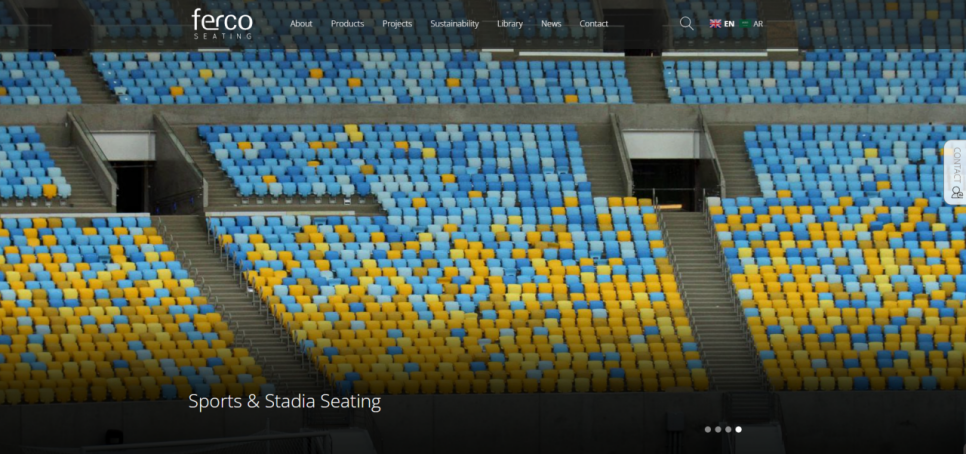
Ferco specializes in high-end performing arts seating. Their focus is often on the ergonomic experience combined with premium upholstery, which offers high absorption coefficients. Their designs are particularly well-suited for venues where “warm” sound is preferred, as their thicker, high-quality cushioning effectively tames mid-to-high frequency reflections.
4. Seatorium
Seatorium provides reliable, fixed seating solutions that prioritize modularity. Their systems are designed to be easily reconfigured or serviced, which is a major benefit for multi-use halls that need to maintain acoustic performance while occasionally altering seating layouts for different event types.
5. Hussey Seating
Hussey Seating excels in the sports and event venue sector. While their primary focus is durability and telescopic functionality, they offer robust seating options that perform well in large-volume environments. Their chairs are engineered to withstand high-impact usage without creating unwanted vibration or structural resonance.

6. Toda Furniture
Toda Furniture focuses on modern, minimalist designs. For venues where contemporary aesthetics are required, their seating profiles are notably slim. From an acoustic perspective, their lower-profile seating can be useful in reducing the physical barrier that causes the seat-dip effect in flat-floored lecture halls.

7. KI
KI offers a wide range of seating that emphasizes flexibility. Their ability to provide high-density solutions makes them a top contender for universities and corporate campuses. Their acoustic performance is consistent, offering a standardized absorption rate that helps engineers design for clear speech intelligibility.
How to Choose: Key Considerations for Acoustic Seating
When selecting seating, the impact of the chair on sound must be treated as part of the overall room HVAC and architectural design.
- Absorption Coefficients: Review the NRC (Noise Reduction Coefficient) ratings for the specific upholstery and foam combination.
- Seat-Dip Mitigation: Consider the rake of the room and the height of the chair back. A higher rake can reduce the grazing incidence of sound over the audience, thereby minimizing the seat-dip effect.
- Occupancy Variability: Determine if the venue will be used at full or partial capacity. The acoustic delta between empty and full rows can be significant; choosing seats with under-seat absorption materials can help bridge this gap.
Final Verdict
There is no “one size fits all” in acoustic design. For projects requiring high levels of custom tuning and acoustic modeling support, Leadcom Seating stands out as the most versatile choice. For large-scale standard auditoriums, legacy brands like Irwin and Hussey offer excellent durability and predictability. Venues focused on luxury should prioritize brands like Ferco for their high-end cushioning properties. Always align your choice with the primary usage of the room: speech-intelligibility spaces favor consistent, standardized absorption, while musical venues benefit from variable-reflectivity surfaces.
Frequently Asked Questions (FAQs)
- Does the seat material significantly affect the sound of the room?
Yes, significantly. Upholstered seats provide high-frequency absorption, while wood or plastic backs provide reflection. The choice of material should be determined by the required reverberation time of the venue.
- What is the “seat-dip effect”?
The seat-dip effect refers to the attenuation of sound at specific frequencies (typically 100 Hz–300 Hz) caused by sound traveling at grazing incidence over rows of seats. It can lead to a perceived loss of bass clarity.
- How can seating density be used to manage acoustics?
Higher seat density can increase the total absorption of the room when occupied. Designers use this to control reverberation times, ensuring the room does not sound “boomy” when full, though it may require balancing with wall treatments to maintain sound quality when the room is empty.
