
Selecting a marine air conditioner requires more than choosing a cooling capacity. Vessel owners, marine equipment buyers, and distributors also need to consider power supply, airflow, installation space, operating noise, and environmental conditions. For small-to-medium-sized boats and yachts, a 12,000 BTU system can be a practical option when its capacity and electrical specifications match the vessel’s actual requirements.
How 12,000 BTU Capacity Supports Cabin Comfort
BTU indicates the amount of heat an air-conditioning system can remove over a given period. A 12,000 BTU marine air conditioner is designed for cabins requiring a moderate level of cooling capacity. However, BTU should not be evaluated alone. Cabin dimensions, insulation, windows, passenger numbers, outdoor temperature, and onboard equipment can all affect the actual cooling load.
Air distribution is another important consideration. A system needs to move conditioned air effectively throughout the cabin while maintaining a comfortable indoor environment. Buyers should therefore review cooling capacity together with air volume and noise level when evaluating marine HVAC equipment. This provides a more practical basis for determining whether a unit is appropriate for a particular vessel.
For vessel projects with changing seasonal requirements, heating capacity can also be relevant. The MAR-220V/12BP is designed for both cooling and heating, allowing the same unit to support cabin temperature management in different operating conditions. This dual-function design can be useful where available installation space is limited and separate heating equipment is less practical.
Power, Airflow and Inverter Performance
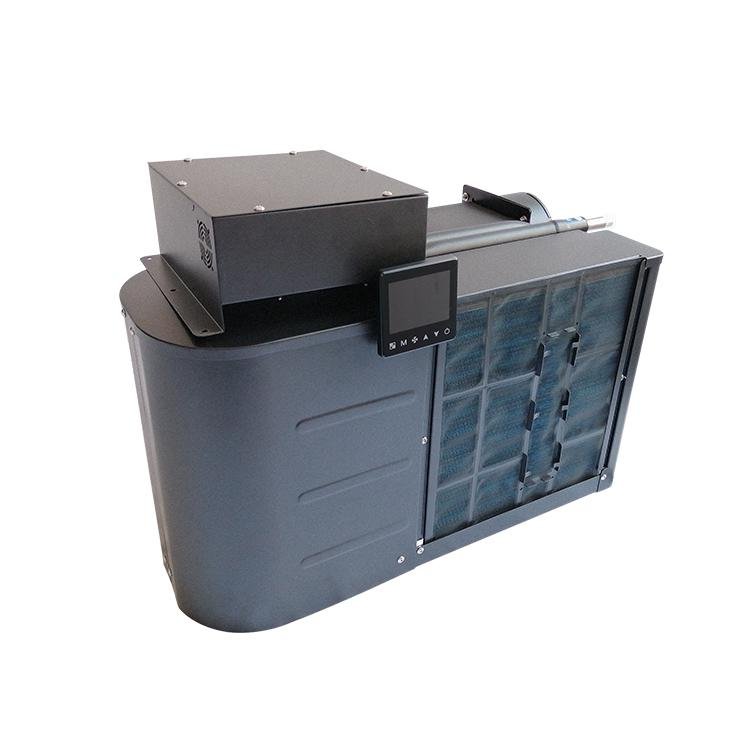
The ZhuoliMarine MAR-220V/12BP provides 12,000 BTU of cooling capacity and 13,450 BTU of heating capacity. The unit uses an AC-220V, single-phase, 60 Hz power supply. Its rated power input is 1,020 W, with a rated current of 4.6 A and a maximum power input of 1,227 W.
Airflow is rated at 650 m³/h, while the water flow volume is 1,080 L/h. These specifications give installers useful reference points when assessing the vessel’s electrical and water-circulation requirements. The unit also uses variable-frequency inverter technology, allowing compressor output to adapt to changing cabin loads.
Inverter operation is particularly relevant for marine applications because cabin conditions can change during operation. Adjusting compressor output according to demand can support more consistent temperature control while avoiding unnecessary fixed-speed operation. For distributors and marine equipment brands, inverter technology is therefore an important specification to consider when selecting equipment for different vessel applications.
The wider ZhuoliMarine range also uses inverter technology across its AC and DC self-contained marine air conditioners. According to the company’s product information, the systems are designed to automatically adjust power output according to load demand, while the available voltage configurations allow equipment to be matched with different vessel power architectures.
Noise performance also affects onboard comfort. The MAR-220V/12BP has a specified noise level of 42/52 dB(A), making noise an identifiable factor for buyers planning installations in cabins, staterooms, or other occupied areas.
Installation and Marine Environmental Requirements
Marine HVAC equipment operates under conditions that differ from typical land-based air-conditioning applications. Humidity, saltwater exposure, vibration, and restricted installation space can all influence equipment selection. Buyers should therefore check the specifications of the exact model instead of assuming that every unit in a product range has identical protection or construction features.
The MAR-220V/12BP has a waterproof grade of IPX4 and an anti-shock grade of I. Its refrigerant is R410A, with a listed refrigerant charge of 560 g. The unit measures 590 × 345 × 345 mm and has a net weight of 26 kg. These dimensions can help installers evaluate available equipment space before finalizing the layout.
The product page also identifies anti-corrosion construction, shock-resistant design, low-noise operation, and variable-frequency control as key features. Such specifications are relevant for vessels exposed to humid and saltwater environments, where equipment needs to be selected with marine operating conditions in mind.
The compact self-contained configuration also places the main air-conditioning components within one unit. ZhuoliMarine describes its self-contained marine AC systems as all-in-one units intended for individual cabin cooling and heating. This configuration can simplify space planning onboard because a separate condenser arrangement is not required, which is useful when installation areas are restricted.
Choosing a 12,000 BTU Marine Air Conditioner
A 12,000 BTU marine air conditioner should be matched to the vessel’s cabin size, insulation, occupancy, climate, and operating conditions. Buyers should also compare cooling and heating capacity, airflow, noise, dimensions, and protection rating. For distributors, power configuration is particularly important. ZhuoliMarine offers AC and DC inverter marine air conditioners in different voltage configurations, including 12V, 24V, 48V, 110V, 220V, and 230V, depending on the model.
AC and DC models should always be evaluated according to their exact voltage specifications. DC systems can suit vessels using battery-based power, while AC models can serve vessels with compatible AC systems. Distributors can also benefit from multiple capacities and voltage options when supplying different vessel projects. ZhuoliMarine provides a one-year warranty for its marine air-conditioning products, which is another important consideration during procurement.
ZhuoliMarine provides inverter-driven AC and DC marine air-conditioning solutions for different vessel applications, with multiple voltage and capacity options for different onboard requirements. Contact ZhuoliMarine to discuss the right marine HVAC configuration for your vessel project.
